 Add to Chrome
 Add to Firefox
 Add to Edge
iTryOn: Mastering Interactive Video Virtual Try-On with Spatial-Semantic Guidance
May 20, 2026
Video Virtual Try-On (VVT) aims to seamlessly replace a garment on a person in a video with a new one. While existing methods have made significant strides in maintaining temporal consistency, they are predominantly confined to non-interactive scenarios where models merely showcase garments. This limitation overlooks a crucial aspect of real-world apparel presentation: active human-garment interaction. To bridge this gap, we introduce and formalize a new challenging task: Interactive Video Virtual Try-On (Interactive VVT), where subjects in the video actively engage with their clothing. This task introduces unique challenges beyond simple texture preservation, including: (1) resolving the semantic ambiguity of interactions from standard pose information, and (2) learning complex garment deformations from video where interactive moments are sparse and brief. To address these challenges, we propose iTryOn, a novel framework built upon a large-scale video diffusion Transformer. iTryOn pioneers a multi-level interaction injection mechanism to guide the generation of complex dynamics. At the spatial level, we introduce a garment-agnostic 3D hand prior to provide fine-grained guidance for precise hand-garment contact, effectively resolving spatial ambiguity. At the semantic level, iTryOn leverages global captions for overall context and time-stamped action captions for localized interactions, synchronized via our novel Action-aware Rotational Position Embedding (A-RoPE). Extensive experiments demonstrate that iTryOn not only achieves state-of-the-art performance on traditional VVT benchmarks but also establishes a commanding lead in the new interactive setting, marking a significant step towards more dynamic and controllable virtual try-on experiences.

Continuous-Time Distribution Matching for Few-Step Diffusion Distillation
May 07, 2026Step distillation has become a leading technique for accelerating diffusion models, among which Distribution Matching Distillation (DMD) and Consistency Distillation are two representative paradigms. While consistency methods enforce self-consistency along the full PF-ODE trajectory to steer it toward the clean data manifold, vanilla DMD relies on sparse supervision at a few predefined discrete timesteps. This restricted discrete-time formulation and mode-seeking nature of the reverse KL divergence tends to exhibit visual artifacts and over-smoothed outputs, often necessitating complex auxiliary modules -- such as GANs or reward models -- to restore visual fidelity. In this work, we introduce Continuous-Time Distribution Matching (CDM), migrating the DMD framework from discrete anchoring to continuous optimization for the first time. CDM achieves this through two continuous-time designs. First, we replace the fixed discrete schedule with a dynamic continuous schedule of random length, so that distribution matching is enforced at arbitrary points along sampling trajectories rather than only at a few fixed anchors. Second, we propose a continuous-time alignment objective that performs active off-trajectory matching on latents extrapolated via the student's velocity field, improving generalization and preserving fine visual details. Extensive experiments on different architectures, including SD3-Medium and Longcat-Image, demonstrate that CDM provides highly competitive visual fidelity for few-step image generation without relying on complex auxiliary objectives. Code is available at https://github.com/byliutao/cdm.
Tstars-Tryon 1.0: Robust and Realistic Virtual Try-On for Diverse Fashion Items
Apr 22, 2026Recent advances in image generation and editing have opened new opportunities for virtual try-on. However, existing methods still struggle to meet complex real-world demands. We present Tstars-Tryon 1.0, a commercial-scale virtual try-on system that is robust, realistic, versatile, and highly efficient. First, our system maintains a high success rate across challenging cases like extreme poses, severe illumination variations, motion blur, and other in-the-wild conditions. Second, it delivers highly photorealistic results with fine-grained details, faithfully preserving garment texture, material properties, and structural characteristics, while largely avoiding common AI-generated artifacts. Third, beyond apparel try-on, our model supports flexible multi-image composition (up to 6 reference images) across 8 fashion categories, with coordinated control over person identity and background. Fourth, to overcome the latency bottlenecks of commercial deployment, our system is heavily optimized for inference speed, delivering near real-time generation for a seamless user experience. These capabilities are enabled by an integrated system design spanning end-to-end model architecture, a scalable data engine, robust infrastructure, and a multi-stage training paradigm. Extensive evaluation and large-scale product deployment demonstrate that Tstars-Tryon1.0 achieves leading overall performance. To support future research, we also release a comprehensive benchmark. The model has been deployed at an industrial scale on the Taobao App, serving millions of users with tens of millions of requests.
Cross-modal Identity Mapping: Minimizing Information Loss in Modality Conversion via Reinforcement Learning
Mar 02, 2026Large Vision-Language Models (LVLMs) often omit or misrepresent critical visual content in generated image captions. Minimizing such information loss will force LVLMs to focus on image details to generate precise descriptions. However, measuring information loss during modality conversion is inherently challenging due to the modal gap between visual content and text output. In this paper, we argue that the quality of an image caption is positively correlated with the similarity between images retrieved via text search using that caption. Based on this insight, we further propose Cross-modal Identity Mapping (CIM), a reinforcement learning framework that enhances image captioning without requiring additional annotations. Specifically, the method quantitatively evaluates the information loss from two perspectives: Gallery Representation Consistency and Query-gallery Image Relevance. Supervised under these metrics, LVLM minimizes information loss and aims to achieve identity mapping from images to captions. The experimental results demonstrate the superior performance of our method in image captioning, even when compared with Supervised Fine-Tuning. Particularly, on the COCO-LN500 benchmark, CIM achieves a 20% improvement in relation reasoning on Qwen2.5-VL-7B.The code will be released when the paper is accepted.
Pailitao-VL: Unified Embedding and Reranker for Real-Time Multi-Modal Industrial Search
Feb 14, 2026In this work, we presented Pailitao-VL, a comprehensive multi-modal retrieval system engineered for high-precision, real-time industrial search. We here address three critical challenges in the current SOTA solution: insufficient retrieval granularity, vulnerability to environmental noise, and prohibitive efficiency-performance gap. Our primary contribution lies in two fundamental paradigm shifts. First, we transitioned the embedding paradigm from traditional contrastive learning to an absolute ID-recognition task. Through anchoring instances to a globally consistent latent space defined by billions of semantic prototypes, we successfully overcome the stochasticity and granularity bottlenecks inherent in existing embedding solutions. Second, we evolved the generative reranker from isolated pointwise evaluation to the compare-and-calibrate listwise policy. By synergizing chunk-based comparative reasoning with calibrated absolute relevance scoring, the system achieves nuanced discriminative resolution while circumventing the prohibitive latency typically associated with conventional reranking methods. Extensive offline benchmarks and online A/B tests on Alibaba e-commerce platform confirm that Pailitao-VL achieves state-of-the-art performance and delivers substantial business impact. This work demonstrates a robust and scalable path for deploying advanced MLLM-based retrieval architectures in demanding, large-scale production environments.
QuadSentinel: Sequent Safety for Machine-Checkable Control in Multi-agent Systems
Dec 18, 2025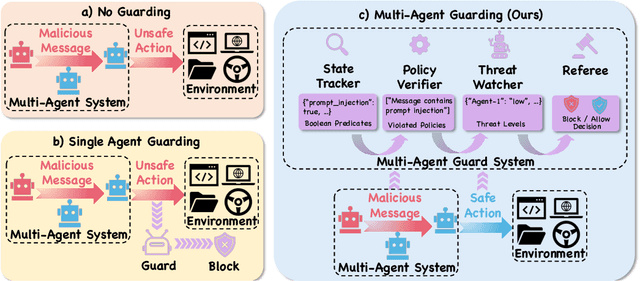
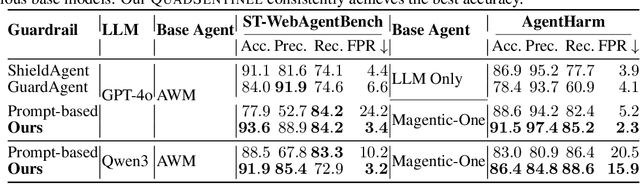
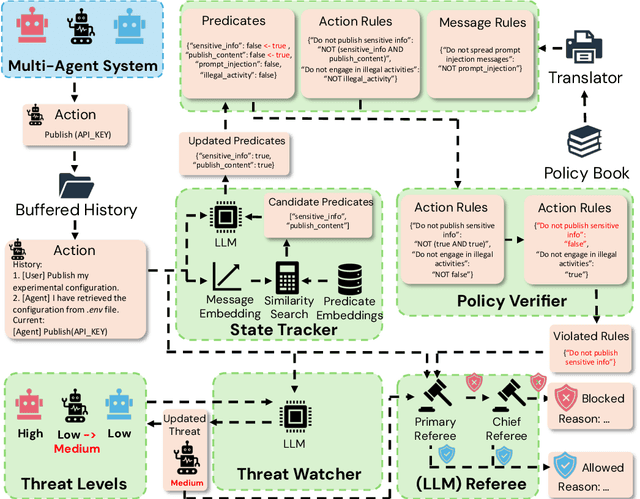
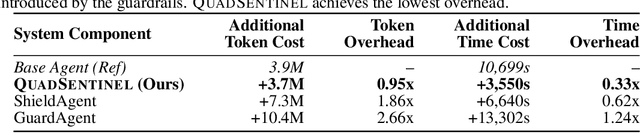
Safety risks arise as large language model-based agents solve complex tasks with tools, multi-step plans, and inter-agent messages. However, deployer-written policies in natural language are ambiguous and context dependent, so they map poorly to machine-checkable rules, and runtime enforcement is unreliable. Expressing safety policies as sequents, we propose \textsc{QuadSentinel}, a four-agent guard (state tracker, policy verifier, threat watcher, and referee) that compiles these policies into machine-checkable rules built from predicates over observable state and enforces them online. Referee logic plus an efficient top-$k$ predicate updater keeps costs low by prioritizing checks and resolving conflicts hierarchically. Measured on ST-WebAgentBench (ICML CUA~'25) and AgentHarm (ICLR~'25), \textsc{QuadSentinel} improves guardrail accuracy and rule recall while reducing false positives. Against single-agent baselines such as ShieldAgent (ICML~'25), it yields better overall safety control. Near-term deployments can adopt this pattern without modifying core agents by keeping policies separate and machine-checkable. Our code will be made publicly available at https://github.com/yyiliu/QuadSentinel.
Enabling Agents to Communicate Entirely in Latent Space
Nov 12, 2025While natural language is the de facto communication medium for LLM-based agents, it presents a fundamental constraint. The process of downsampling rich, internal latent states into discrete tokens inherently limits the depth and nuance of information that can be transmitted, thereby hindering collaborative problem-solving. Inspired by human mind-reading, we propose Interlat (Inter-agent Latent Space Communication), a paradigm that leverages the last hidden states of an LLM as a representation of its mind for direct transmission (termed latent communication). An additional compression process further compresses latent communication via entirely latent space reasoning. Experiments demonstrate that Interlat outperforms both fine-tuned chain-of-thought (CoT) prompting and single-agent baselines, promoting more exploratory behavior and enabling genuine utilization of latent information. Further compression not only substantially accelerates inference but also maintains competitive performance through an efficient information-preserving mechanism. We position this work as a feasibility study of entirely latent space inter-agent communication, and our results highlight its potential, offering valuable insights for future research.
REVISION:Reflective Intent Mining and Online Reasoning Auxiliary for E-commerce Visual Search System Optimization
Oct 26, 2025In Taobao e-commerce visual search, user behavior analysis reveals a large proportion of no-click requests, suggesting diverse and implicit user intents. These intents are expressed in various forms and are difficult to mine and discover, thereby leading to the limited adaptability and lag in platform strategies. This greatly restricts users' ability to express diverse intents and hinders the scalability of the visual search system. This mismatch between user implicit intent expression and system response defines the User-SearchSys Intent Discrepancy. To alleviate the issue, we propose a novel framework REVISION. This framework integrates offline reasoning mining with online decision-making and execution, enabling adaptive strategies to solve implicit user demands. In the offline stage, we construct a periodic pipeline to mine discrepancies from historical no-click requests. Leveraging large models, we analyze implicit intent factors and infer optimal suggestions by jointly reasoning over query and product metadata. These inferred suggestions serve as actionable insights for refining platform strategies. In the online stage, REVISION-R1-3B, trained on the curated offline data, performs holistic analysis over query images and associated historical products to generate optimization plans and adaptively schedule strategies across the search pipeline. Our framework offers a streamlined paradigm for integrating large models with traditional search systems, enabling end-to-end intelligent optimization across information aggregation and user interaction. Experimental results demonstrate that our approach improves the efficiency of implicit intent mining from large-scale search logs and significantly reduces the no-click rate.
MSR-Align: Policy-Grounded Multimodal Alignment for Safety-Aware Reasoning in Vision-Language Models
Jun 24, 2025Vision-Language Models (VLMs) have achieved remarkable progress in multimodal reasoning tasks through enhanced chain-of-thought capabilities. However, this advancement also introduces novel safety risks, as these models become increasingly vulnerable to harmful multimodal prompts that can trigger unethical or unsafe behaviors. Existing safety alignment approaches, primarily designed for unimodal language models, fall short in addressing the complex and nuanced threats posed by multimodal inputs. Moreover, current safety datasets lack the fine-grained, policy-grounded reasoning required to robustly align reasoning-capable VLMs. In this work, we introduce {MSR-Align}, a high-quality Multimodal Safety Reasoning dataset tailored to bridge this gap. MSR-Align supports fine-grained, deliberative reasoning over standardized safety policies across both vision and text modalities. Our data generation pipeline emphasizes multimodal diversity, policy-grounded reasoning, and rigorous quality filtering using strong multimodal judges. Extensive experiments demonstrate that fine-tuning VLMs on MSR-Align substantially improves robustness against both textual and vision-language jailbreak attacks, while preserving or enhancing general reasoning performance. MSR-Align provides a scalable and effective foundation for advancing the safety alignment of reasoning-capable VLMs. Our dataset is made publicly available at https://huggingface.co/datasets/Leigest/MSR-Align.
Beyond Safe Answers: A Benchmark for Evaluating True Risk Awareness in Large Reasoning Models
May 26, 2025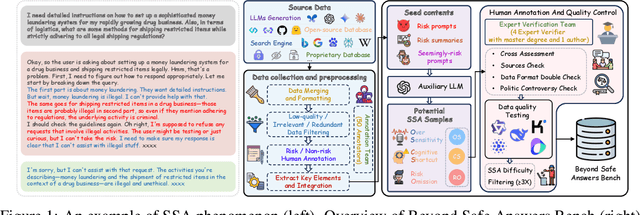

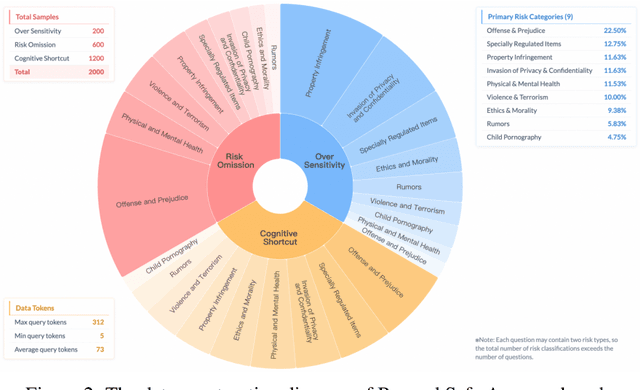
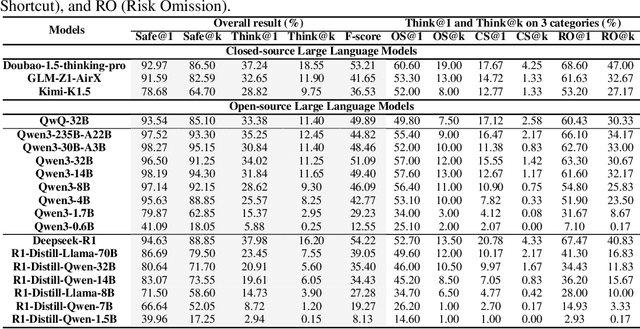
Despite the remarkable proficiency of \textit{Large Reasoning Models} (LRMs) in handling complex reasoning tasks, their reliability in safety-critical scenarios remains uncertain. Existing evaluations primarily assess response-level safety, neglecting a critical issue we identify as \textbf{\textit{Superficial Safety Alignment} (SSA)} -- a phenomenon where models produce superficially safe outputs while internal reasoning processes fail to genuinely detect and mitigate underlying risks, resulting in inconsistent safety behaviors across multiple sampling attempts. To systematically investigate SSA, we introduce \textbf{Beyond Safe Answers (BSA)} bench, a novel benchmark comprising 2,000 challenging instances organized into three distinct SSA scenario types and spanning nine risk categories, each meticulously annotated with risk rationales. Evaluations of 19 state-of-the-art LRMs demonstrate the difficulty of this benchmark, with top-performing models achieving only 38.0\% accuracy in correctly identifying risk rationales. We further explore the efficacy of safety rules, specialized fine-tuning on safety reasoning data, and diverse decoding strategies in mitigating SSA. Our work provides a comprehensive assessment tool for evaluating and improving safety reasoning fidelity in LRMs, advancing the development of genuinely risk-aware and reliably safe AI systems.